

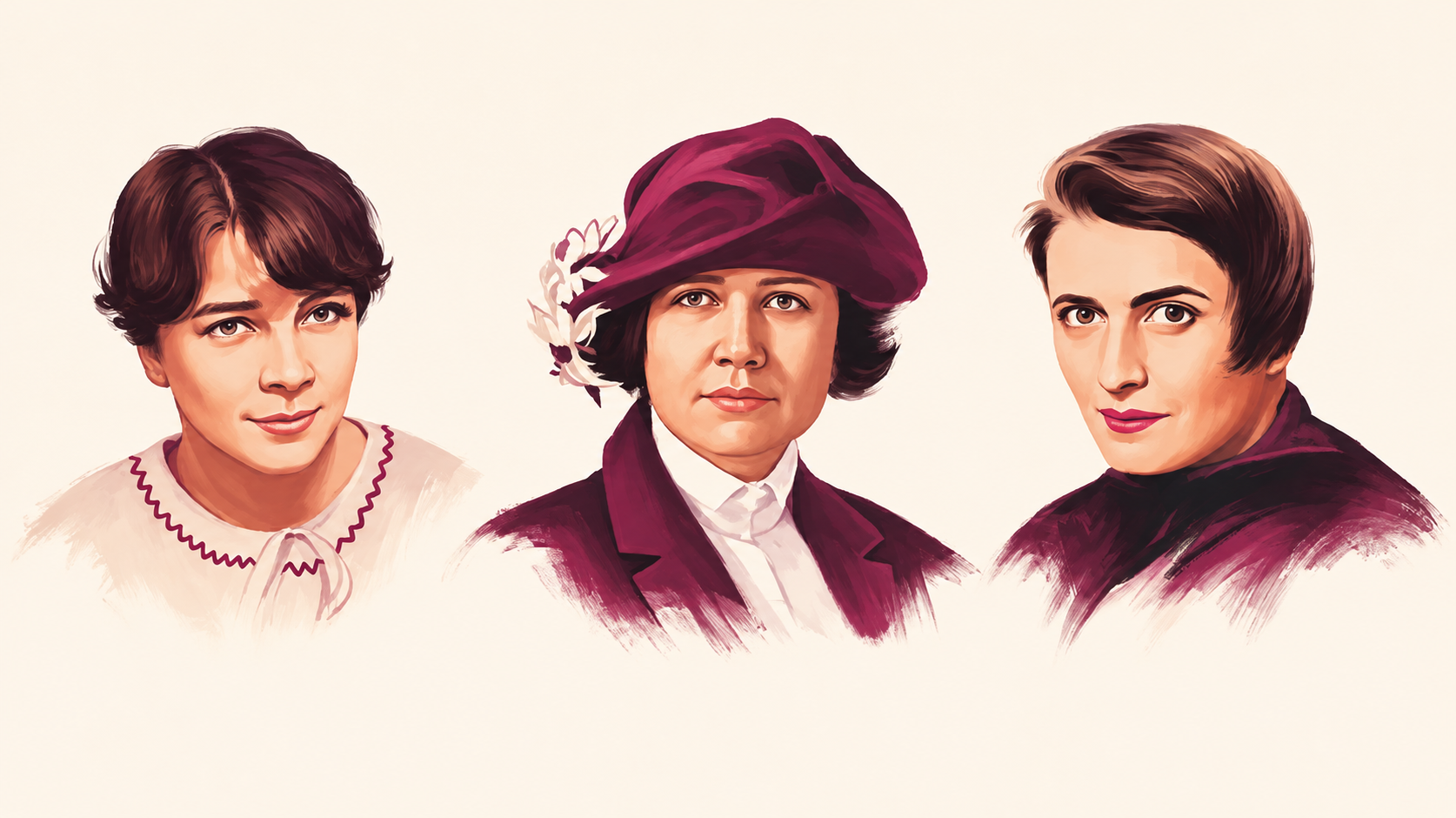
The Founding Mothers of Libertarianism

In 1943, the world was at war, and many of the most respected thinkers in America and Europe believed that the future belonged to planned economies. Freedom, in the old sense of individuals running their own lives, looked to them like a relic.
That same year, three women published three books that said the opposite. None of them had a university degree in economics or philosophy. One was a former telegraph operator from the Dakota prairie, one was a self-taught book critic from rural Canada, and one was a refugee from Soviet Russia. Together, they helped keep the ideas of liberty alive at a moment when very few people were defending them.
Why “founding mothers”
Isabel Paterson’s biographer, Stephen Cox, called them the “Libertarians of ’43.” William F. Buckley Jr. called them the “three furies of modern libertarianism.” Today, many writers simply call them its founding mothers.
Three books, one year
History
The Discovery of Freedom
Rose Wilder Lane
Human history told as a long struggle between people trying to run their own lives and authorities trying to control them.
Political philosophy
The God of the Machine
Isabel Paterson
A free society compared to an electrical circuit: energy flows when people are free to create and exchange, and stops when power is concentrated.
Novel
The Fountainhead
Ayn Rand
An architect who refuses to compromise his work to please others, and a bestseller that introduced millions of readers to individualism.
Meet the three women
Rose Wilder Lane
1886 to 1968 · Born in Dakota Territory
The daughter of Laura Ingalls Wilder, Rose grew up on the frontier that her mother’s Little House books would make famous. She left home young, worked as a telegraph operator and sold real estate in California before becoming a successful journalist and magazine writer.
- Known forThe Discovery of Freedom (1943)
- Also wroteGive Me Liberty (1936)
- Surprising factShe helped her mother shape the Little House books
“I came out of the Soviet Union no longer a communist, because I believed in personal freedom.”
Read her storyShow less
As a young woman, Rose was drawn to socialism. Then she travelled through Europe and the Middle East with the American Red Cross after the First World War, reporting on famine and devastation, and saw the Soviet Union for herself. She came back convinced that no planned system could replace the freedom of ordinary people to make their own choices.
She spent long stretches of the 1920s in Albania, and later worked closely with her mother to turn Laura’s memories of pioneer life into the Little House books. Many historians see her love of self-reliant, hardworking families in those stories.
From 1942 to 1945 she wrote a weekly column for the Pittsburgh Courier, one of the leading Black newspapers in the United States, where she argued that individual freedom and equal rights belonged to everyone. She kept writing and travelling into old age, and reported from Vietnam at 78.
Isabel Paterson
1886 to 1961 · Born in Ontario, Canada
Isabel grew up on the frontier of western Canada with only a few years of schooling, and educated herself by reading everything she could find. She worked as a waitress, a stenographer and a bookkeeper before becoming a journalist, and in 1912 she even flew in a record-setting altitude flight.
- Known forThe God of the Machine (1943)
- CareerBooks columnist at the New York Herald Tribune, 1924 to 1949
- Surprising factShe was a mentor to the young Ayn Rand
“To live, people must think, and to think, they must be free.”
Read her storyShow less
For 25 years, Paterson wrote a weekly books column for the New York Herald Tribune, signed simply “I.M.P.” She used it to talk about literature, and also to defend individual liberty at a time when that view had gone deeply out of fashion among the people she wrote for.
She also published eight novels before writing The God of the Machine, her great work of political philosophy. Ayn Rand admired it so much that she said it “could literally save the world.” Herbert Hoover read it and wrote her a letter of praise.
Paterson was famously sharp-tongued and independent. She hosted weekly gatherings in New York where young writers, Rand among them, came to argue about ideas. She refused to join movements or organizations, even ones that shared her views. She wanted to think for herself, and she did.
Ayn Rand
1905 to 1982 · Born in St. Petersburg, Russia
Ayn grew up in Russia and watched the new Soviet state confiscate her family’s business after the 1917 revolution. She emigrated alone to the United States in 1926, worked in Hollywood, and taught herself to write novels in a language that wasn’t her own.
- Known forThe Fountainhead (1943)
- Also wroteAtlas Shrugged (1957)
- Surprising factShe refused to call herself a libertarian
“Independence is the only gauge of human virtue and value.”
Read her storyShow less
Rand arrived in New York with little money and very little English. She found work in Hollywood as an extra and a junior screenwriter, and spent the next years writing plays and novels about individuals who refuse to surrender their minds to the crowd.
The Fountainhead was turned down by a long list of publishers before it came out in 1943. It sold slowly at first, then spread mostly by word of mouth, and went on to sell millions of copies. Her later novel, Atlas Shrugged, became one of the most influential books of the twentieth century.
Rand developed her own philosophy, which she called Objectivism, and she was openly critical of the libertarian movement that grew up after her. Yet her moral case for individual freedom drew countless readers to these ideas, which is why she is so often counted among its founders.
What they had in common
They taught themselves
None of them followed an academic path. They learned by reading, working and living through the events of their time.
They saw collectivism up close
Lane and Rand both saw the Soviet experiment with their own eyes, and it shaped everything they wrote afterwards.
They wrote for everyone
History, philosophy, fiction: each one found a way to bring these ideas to ordinary readers, not just to specialists.
They refused to be quiet
All three defended freedom when it was unpopular, and paid a price for it in their careers and friendships.
They also disagreed, often and loudly. They argued about religion, about strategy and about each other, and several of their friendships ended in quarrels. That, in a way, is part of the lesson. A movement built on independent minds will never speak with one voice, and it doesn’t need to.
Why they still matter
When people picture the history of ideas, they usually picture men. The story of the modern liberty movement is a good reminder that this picture is incomplete. At one of its most important moments, it was three women, writing outside the universities and against the spirit of their age, who made the case for freedom in a way that millions of people could understand.
They stand in a line that goes back to Mary Wollstonecraft, who argued in 1792 that women are rational beings with the right to govern their own lives. And it continues today, with women around the world who read, debate and lead with the same independence.
Where to start reading them
- The Discovery of Freedom, Rose Wilder Lane (1943). Short, passionate and easy to read in a weekend.
- The God of the Machine, Isabel Paterson (1943). The most demanding of the three, and the most original.
- The Fountainhead, Ayn Rand (1943). The best entry point if you prefer stories to arguments.
- The Woman and the Dynamo: Isabel Paterson and the Idea of America, Stephen Cox (2004). The definitive biography of Paterson.
Read them together
Lane, Paterson and Rand found each other through conversation, letters and long arguments about ideas. At LOLA, women in cities around the world keep that tradition alive: they meet to read, debate and support each other as leaders. Joining is free.
Sources
- The Women Who Launched a Revolution, Cato Institute
- The Founding Mothers of Libertarianism, Reason
- How Three Women Sought to Sway Americans Away from Socialism, Foundation for Economic Education
- Rose Wilder Lane and Isabel Paterson, Wikipedia
- Libertarians, The Ayn Rand Lexicon