

What are we celebrating this 4th of July?
Sara Urquizu
July 4, 2026
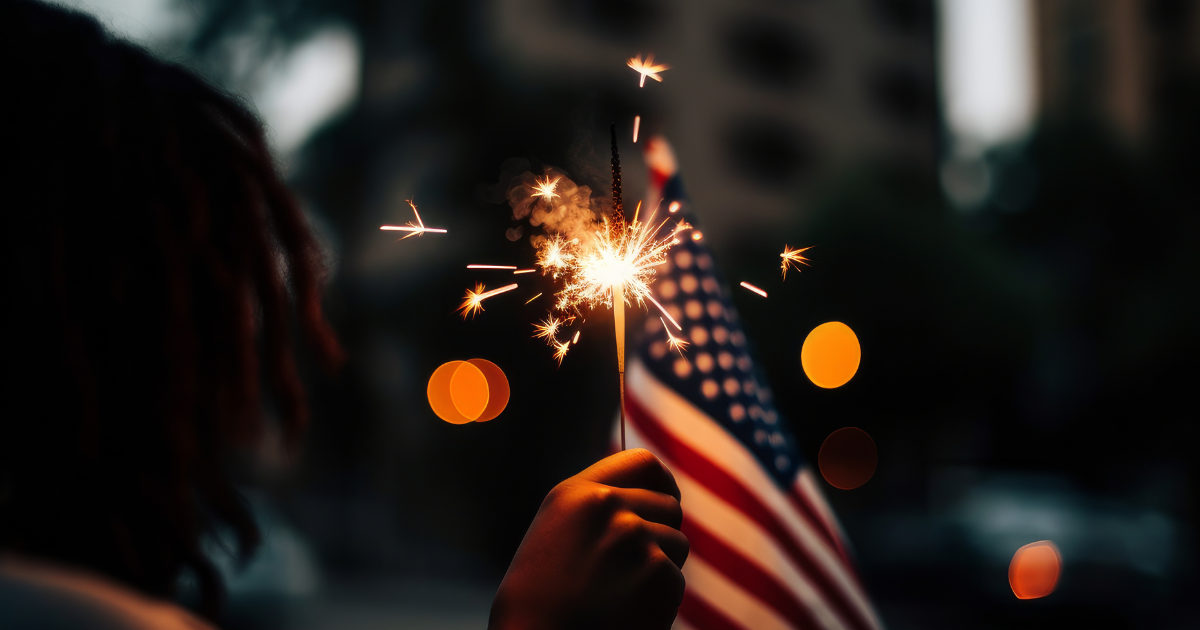
“The price of liberty is eternal vigilance.”
— Phrase attributed to Thomas Jefferson
This is probably one of the most difficult columns I’ve ever written.
Not because I lack reasons to talk about the United States. Quite the opposite. Precisely because I deeply admire the role it played in the history of liberty, writing a critical piece on the occasion of the 250th anniversary of the Declaration of Independence might seem, to some, out of place.
I understand.
This week will be full of articles recalling the Founding Fathers, the Declaration of Independence, the Constitution, and the birth of a nation that forever changed the political history of the West. All those tributes are absolutely deserved.
Still, it’s worth thinking about what exactly we are celebrating.
Two hundred fifty years ago, a group of men formulated one of the most influential phrases in modern political history: that all human beings are born equal and possess inalienable rights, among them life, liberty, and the pursuit of happiness. Those words not only gave rise to a new country; they offered a revolutionary idea about the purpose of government and the limits of power. Precisely because of this, this anniversary invites us to remember that legacy, but also to ask ourselves how much of that spirit remains alive, to reflect on it, and to have the courage to bring to light what very few want to hear.
In 2023 I traveled to the United States for the first time. I confess I did so with great excitement and a very idealized image of the country. Like many Latin American children, I grew up imagining this country through Hollywood and Disney movies. Everything I heard about it gave me the impression that here anything was possible.
The second state I traveled to and was able to explore at length, after Arizona, was California. And touring several areas of Los Angeles and San Francisco, I found a reality very different from the one I had dreamed of. A number of homeless people I never imagined seeing in one of the world’s largest economies, visible drug use, and a sense of vulnerability that, honestly, I didn’t expect to experience. I was surprised to discover that, at times, I felt calmer walking through Latin American cities that usually appear at the top of insecurity rankings.
I especially remember a night in 2025 when I had to return to Los Angeles and was heading from Palm Springs to Union Station by bus, when I got an alert on my phone informing me that a curfew had been declared due to the protests taking place in the city. It turned out that day coincided with Donald Trump’s birthday, and protests by his opponents broke out across the country, especially in the more Democratic states (that is, more progressive or left-leaning). When I got the notification we were already very close to the terminal, and upon arriving I encountered a somewhat frightening atmosphere: a strong police presence, visibly nervous people, and an air of uncertainty that’s hard to describe. I never imagined feeling so much fear arriving in a city that for so many years I had associated with the so-called “American dream.”
Another thing that made me reflect the most was talking with several friends who moved to the United States on sports scholarships, completed their university studies, and today work at top-tier companies — Tesla, for example. I know several such cases because I played tennis for a long time, and that’s where several of these friendships come from. My friends are citizens who pay taxes, generate value, are part of the country’s economic development, and have built their life project here.
However, much of their conversation no longer revolves around their work, but around immigration paperwork, temporary permits, visa renewals, lawyers, and the anxiety of not knowing whether they’ll be able to stay where they’ve already put down roots. I fully understand that illegal immigration represents an enormous challenge for any state. Even so, I find it hard to understand that people who did everything according to the rules face so many obstacles to staying and continuing to contribute to the country where they chose to build their lives.
I could fill entire pages recounting many experiences that helped clarify the real picture for me. In Grand Rapids (Michigan) I was struck by the amount of property taxes charged. In Texas and West Virginia I met professionals who explained to me the problem of occupational licensing and the bureaucracy of the American state. In Nevada, on the way to Las Vegas, some friends and I rented a car and got a ticket for something we hadn’t even done, which the police officer couldn’t explain, making me doubt even the transparency of these institutions. In New York and Atlanta I observed dirty, neglected areas full of propaganda far removed from the ideas of liberty that so genuinely characterized the country.
The curious thing is that none of these experiences, on its own, would have changed my perception of the United States. It was the accumulation of small conversations, everyday scenes, and questions that ended up making me reflect. A tax here, a regulation there; a city more run-down than I imagined; a brilliant friend trapped for years in an immigration process. None of these facts fully explains what’s happening; together, though, they draw a question that’s hard to ignore.
What is happening with the United States?
It would be very easy to interpret this column as mere criticism of the country. It isn’t. The intention is exactly the opposite. On one hand, I’d like to clarify that my travel experiences here have also been quite good; some, even memorable. Going to the Magic Kingdom in Orlando, visiting the Statue of Liberty, watching LeBron James play basketball with the Los Angeles Lakers, seeing the Apple and Google headquarters in Silicon Valley, learning to use firearms for self-defense in Arizona, dancing to Texan music in Austin, kayaking in Grand Rapids, marveling at the hotels in Las Vegas, studying admirable case law at the Arizona Supreme Court, visiting historic museums in Washington and Pennsylvania, going to the beaches of Florida… I could mention countless episodes that made me genuinely admire this country and feel great affection for it. On the other hand, I firmly believe that the United States made fundamental contributions to the history of liberty; that’s why I consider it essential to raise this question on such a symbolic anniversary.
The Declaration of Independence established that all human beings are born with inalienable rights and that governments were conceived to protect them, not to grant them. That idea transformed modern political history. It inspired revolutions, literature, and freedom movements around the world. That’s why the greatness of the United States never consisted solely of its wealth or its power: it lay in having reminded the world that the purpose of government is not to direct people’s lives, but to allow them to freely pursue their own project of happiness.
Two hundred fifty years later, the test is still ongoing.
Liberty has never been a destination one reaches once and for all. It is a balance that must be preserved generation after generation. No society is immune to the growth of political power, regulatory excess, the expansion of public spending, or the weakening of the institutions that contributed to its prosperity.
That’s the biggest lesson all my experiences here left me with: no country is immune to backsliding. Not even the one that for so long was the greatest standard-bearer of the ideas of liberty.
That’s why I believe this anniversary requires something more than fireworks: it requires reflection. Because nations don’t stop being free overnight. The loss is usually gradual, almost imperceptible. One more regulation, one additional tax, one longer bureaucratic process, one institution slowly weakening: each change seems small when viewed in isolation; the result only becomes evident with the passage of years.
Perhaps that’s why the phrase attributed to Thomas Jefferson remains so relevant: “The price of freedom is eternal vigilance.” It’s not enough to celebrate the liberty we inherited; we must ask ourselves whether we are still protecting it and still deserving of it.
And perhaps that is precisely the question we should ask ourselves this Fourth of July.
If 250 years ago the promise was to guarantee life, liberty, and the pursuit of happiness, the key question we should ask today is not how much the United States has prospered, but how much it retains of that ideal that made it a beacon for millions of people around the world.
Because the most important commemorations don’t just look backward. They also serve to ask ourselves where we want to go.
And that is the question we must ask ourselves this Fourth of July: What are we celebrating? The history of an extraordinary nation, or the principles that made that history possible?
Happy Fourth of July, 2026!