

The standard the mafia has and the STF has lost
Letícia Barros
September 18, 2026
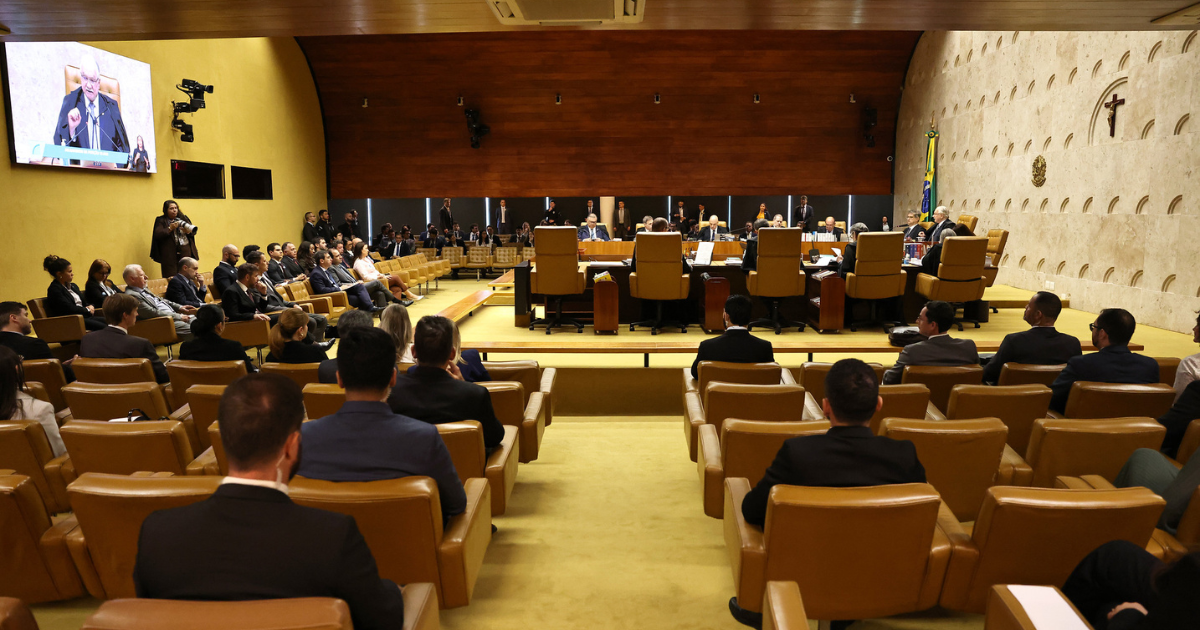
On a historic Tuesday, September 15, the ten justices of the Supreme Federal Court (STF) settled into their comfortable caramel-coloured armchairs to convene the full bench. The agenda, though scandalous, was simple: whether or not to authorise an investigation into Alexandre de Moraes, after a lifting of confidentiality revealed personal conversations with banker Daniel Vorcaro.
“Does someone really need to push the chairs in for the justices to sit down?” was the comment of just one of the thousands of outraged Brazilians following the session. That was the first impression left by the opening minutes of the broadcast: the servility and excessive protocol surrounding those who stand above everything and everyone.
Justice Edson Fachin, the Court’s current president, opened his speech by talking about good sense, decorum, and serenity. He invoked January 8, claiming that the Supreme Court had acted in accordance with the Federal Constitution. He raised the need to resist the violence of arbitrary power. A speech that, although intended to project seriousness and confidence, only laid bare the contrast between genuinely constitutional conduct and the spectacle of self-preservation that would take over the chamber in the hours that followed.
The session began with the aim of determining whether there was sufficient evidence to open an investigation into Moraes. What was at stake was not convicting anyone, nor removing anyone from office. It was merely deciding whether, based on indications that a Supreme Court justice was involved in the country’s biggest banking scandal, an investigation should be opened – something that, undoubtedly, should not even have been up for debate.
In a Republic characterised by the exchange of favours and political cronyism, Justices Kassio Nunes and Dias Toffoli recused themselves from the discussion. What followed was the portrait of a Court with plenty of energy to squabble over procedure and no hurry whatsoever to combat the corruption plaguing the country.
For an entire afternoon, the Brazilian people were forced to watch a veritable circus televised in real time: shouting matches, jokes, laughter, and Flávio Dino’s relentless main character syndrome – more concerned with virtue signalling and accusing colleagues than with actually leaving the room with real progress for the Brazilian people, who are begging for answers.
Even more serious than a court that sees no urgency in investigating a colleague whose family held a multimillion-real contract with a corrupt banker was the presence of Alexandre de Moraes himself, who was there to vote in his own favour. One does not need a law degree to know that there should be no room whatsoever for the person under investigation to have a vote on their own case.
After a round of flattery, Gilmar Mendes threw a veritable tantrum, accusing Justice André Mendonça of acting with political bias. By claiming that “even a colleague who may be involved cannot be subjected to this kind of humiliation,” Gilmar confirmed what was already evident to many Brazilians: the STF has ceased to be a constitutional court and has become a sanctuary of protection and shielding for a small group of tyrants and egomaniacs who have never received a single vote.
At the end of the performance, Cármen Lúcia apologised to the Brazilian people. We do not accept. Lamentation and inaction do not change the course of the country. And to Justice Gilmar Mendes, who said that even the mafia has ethics: message received, Justice. If not even the mafia can serve as our yardstick, it is because there is no yardstick at all. The Supreme Federal Court has definitively lost the integrity that the Constitution entrusted to it.
Originally published in Portuguese by Crusoé.