

Renan Santos and the judiciary that dictates the algorithm's recommendations
Letícia Barros
September 4, 2026
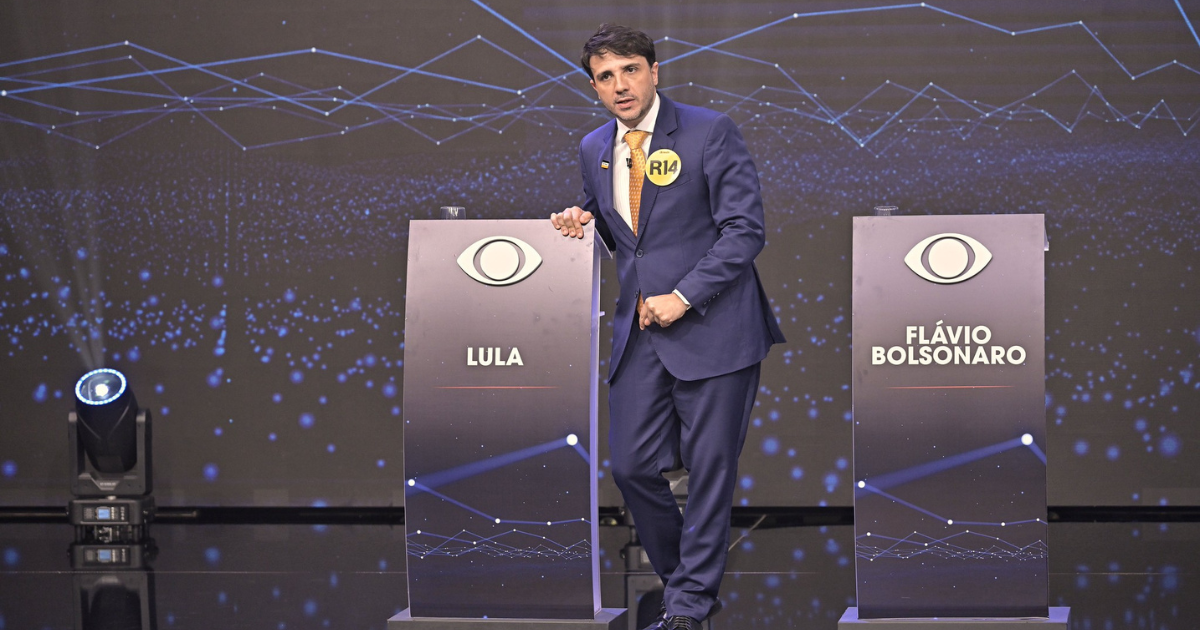
The predictable single-judge ruling by the TSE (Superior Electoral Court) to knock a piece off the board of the presidential race finally came, fourteen days after the campaign began. Perhaps it was not so predictable for candidate Renan Santos, who in 2021 publicly applauded Moraes’s authoritarian actions against Bolsonaro and his allies. Now, with his digital campaign suspended by Justice Dias Toffoli, Renan has felt firsthand that cheering the fire while your neighbour burns is convenient – only until you become the neighbour.
To understand the scale of the abuse, one needs to know the rule Toffoli claims to be applying. Law 9.504/97 and TSE Resolution 23.610/19 require candidates to inform the Electoral Court of all profiles and channels they will use in the campaign. The National Directorate of the Missão party supplemented Renan’s registration with new social media accounts three days after the campaign began. Under the law, pre-existing channels that were not reported can only be used 48 hours after registration, and the only penalty provided for this delay is a fine.
Toffoli, however, imposed three forms of censorship on the candidate: suspension of digital advertising, suspension of electoral funding, and a ban on participating in debates. One does not need any technical or legal knowledge to see how unreasonable it is to apply such extreme sanctions to a merely bureaucratic lapse – and this is where the decision’s character lies, not merely disproportionate but illegal and dictatorial. Less than 48 hours later, perhaps recognising his own excesses, Toffoli himself backed down on the penalties.
The ruling itself acknowledged that registration irregularities are normally curable and do not bar a candidate. What Toffoli did was carve out an exception to this general rule, without proving intent and without giving the party any chance to respond beforehand. In fact, the situation is even worse: the “evidence” attached to the ruling consists of screenshots taken by the justice himself while browsing Instagram. The law became an instrument for an abusive interpretation that blatantly tramples constitutional freedoms.
The rules in the TSE Resolution underpinning the decision are even more illogical. They require platforms to exclude from their recommendations any profile registered with the Electoral Court. And they go further: they prohibit social media artificial intelligence from ranking, recommending, or prioritising candidates, even if the user themselves asks for it. In practice, the state dictates how a private company’s algorithm must treat political content, against the will of those who use it.
It was on the basis of these rules that Toffoli took a screenshot of the “suggested accounts” tab on Renan’s profile and found other candidates from the same party there. That recommendation is not campaign manipulation; it is Instagram’s algorithm doing what it does with any popular account, in any niche. Toffoli treated the normal functioning of the algorithmic system as evidence of fraud, presuming bad faith from behaviour that would have occurred anyway, with any profile.
The absurdity is compounded for two reasons. First: today, social media is not only a fundamental part of any political campaign, but a democratic space for freedom of expression, of the press, and of thought. Second: a justice who had to step down as rapporteur of the country’s biggest banking scandal, amid suspicions of closeness to those under investigation, is exactly the kind of figure who should not be granted unilateral power to decide the fate of a presidential candidacy.
It is no coincidence that, one day after threatening a presidential candidacy, Toffoli took the stage in Rio de Janeiro to declare that “attacking the judiciary is attacking the poor.” It is the same shielding instinct: whoever concentrates enough power to single-handedly decide the fate of an election also wants to decide, single-handedly, who has the right to question him. Renan Santos discovered, too late, the price of having applauded this instinct when it was aimed at others. The rest of the country should pay attention before it is their turn.
Originally published in Portuguese by Crusoé.